
Topic 1: EQUITY: SHIFTING WINDS
September 2026 was one of the weakest months in years for Indian equities, with both the Nifty 50 and the BSE Sensex recording their second consecutive monthly decline. According to the newer reference text, the Nifty 50 fell 6.06% on a spot month-end basis, losing about 1,472 points to close at 22,620.45 on September 30. The Sensex fell about 5.8%, losing roughly 4,476 points to close at 72,480.29. The Nifty's September derivatives series return was reported at about -6.7%, which one source called the worst September in 25 years, so the figure depends on whether month-end spot levels or the derivatives series is used. The earlier text had slightly milder numbers, with the Nifty down about 5.7% and the Sensex down about 5.3% to 5.5%, ending near 72,700 to 72,800. Taken together, the sources agree on a severe correction, with the Nifty down roughly 5.7% to 6.7% and the Sensex roughly 5.3% to 5.8%, and both benchmarks near six-month lows.
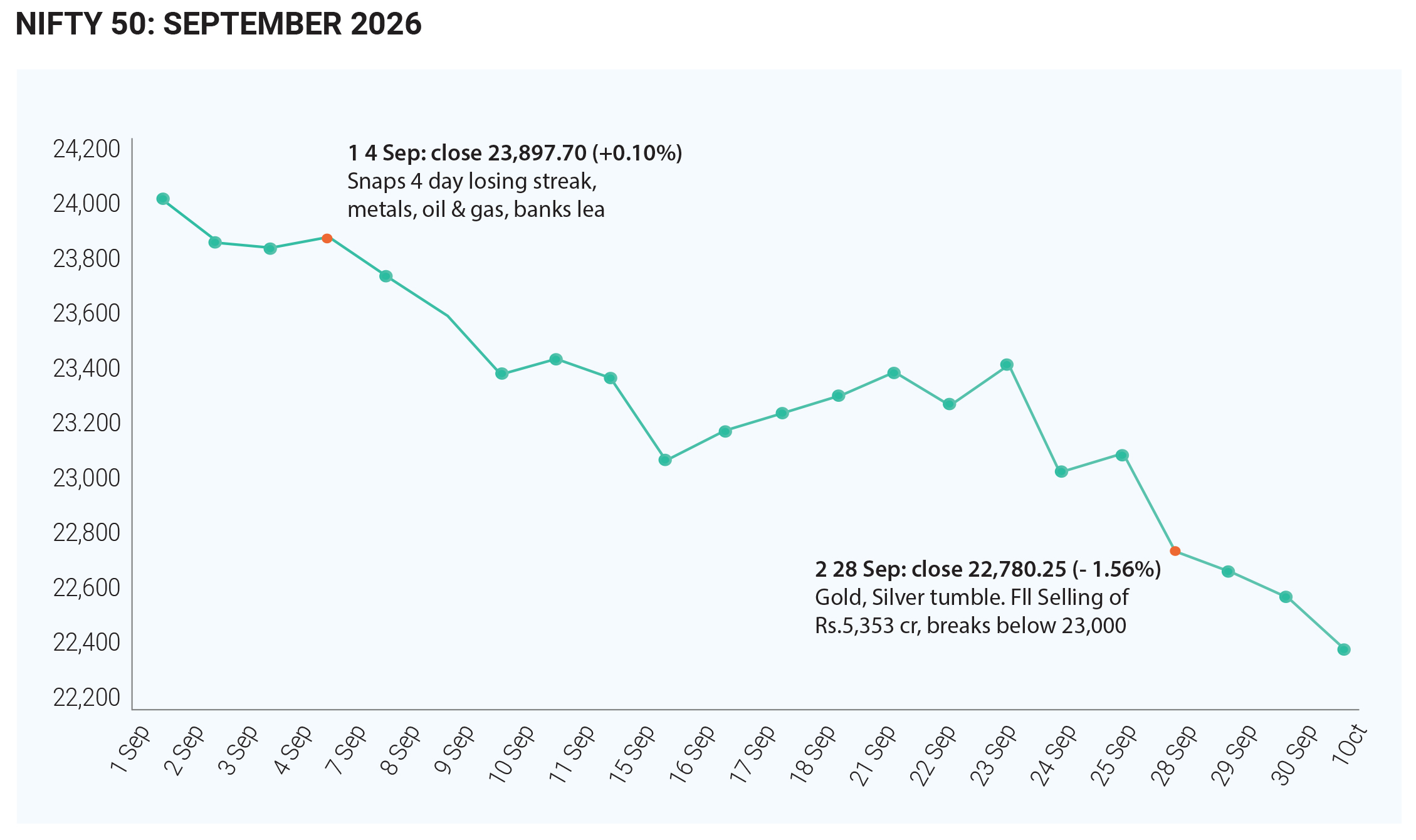
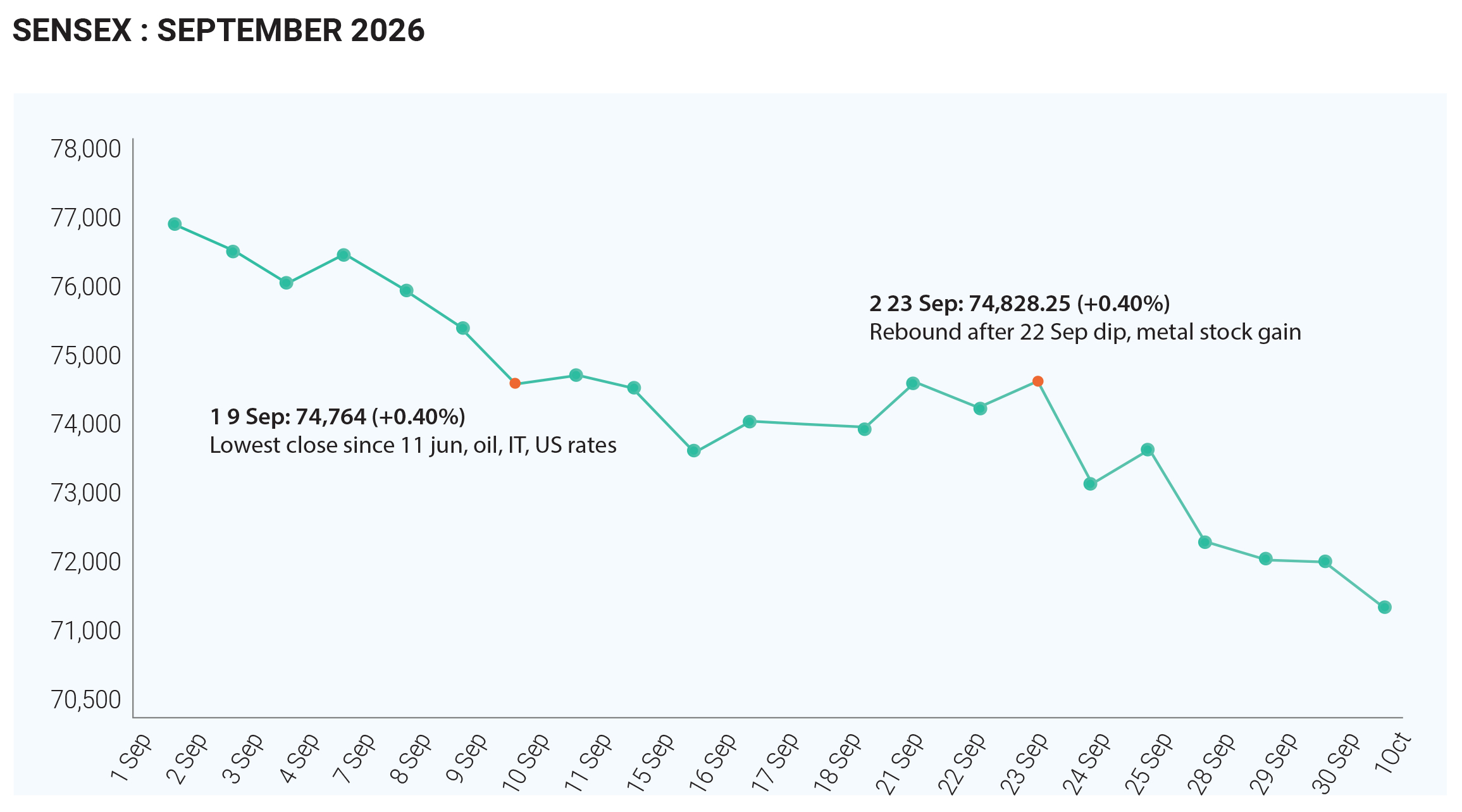
The month unfolded in stages. Markets were cautious early on because of geopolitical tensions, and the correction intensified as crude oil rose and foreign selling resumed. By mid-month, the Sensex had already lost more than 2,900 points, or about 3.84%, and the Nifty had slipped below key technical support levels as investors reacted to higher US bond yields, elevated oil and worries about the Federal Reserve's policy path. Volatility was high. On 15th September, the Sensex opened 655 points higher but closed 778 points lower, a 1,432-point round trip. On 29th September the Nifty broke below the psychologically important 22,600 level while the Sensex fell more than 1%. On 30th September, the Nifty ended down 0.42% and the Sensex down 0.07% The primary factor was a crude oil shock. Brent rose above 100 to 105 dollars per barrel, and by some accounts reached 107 to 108, on Middle East supply and shipping concerns, including a stalemate in US-Iran peace talks and fears of disruption through the Strait of Hormuz. For India, costlier oil widens the import bill and the current account deficit, raises inflation risks, squeezes corporate margins and weakens the rupee. The rupee slid toward and beyond 96 per dollar, adding to worries about imported inflation and tighter domestic financial conditions. Global yields were the second major pressure. The US 10-year Treasury yield rose above 5.2%, its highest level since 2007. That made dollar bonds more attractive relative to emerging-market equities and raised the discount rates applied to Indian corporate earnings, reducing the valuations investors were willing to pay, especially for growth stocks. Firm yields, higher crude and a weaker rupee also raised concerns that inflation would stay sticky and that the Reserve Bank of India might hold policy tight, further pressurising rate-sensitive sectors such as banks, financials, real estate and consumer businesses. Domestic data added to the caution: August CPI inflation was a hotter-than-expected 4.82%, and Maharashtra declared drought in 74% of its talukas, raising concerns about rural demand. A busy IPO calendar and heavy block-deal supply also absorbed part of the available domestic liquidity Foreign institutional investors (FIIs) were decreasing their exposure which have turned from net buyers in July and August to aggressive sellers. FII net selling was about 44,013 crore rupees, across 16 of 21 sessions, with another estimate of about 2.7 billion dollars in outflows, and according to the NSE series, put it at about 33,864 crore across 15 of 20 sessions, with a largest single-day sale of about 9,980 crore on September 29. The selling created broad pressure on large caps in financials, IT and other heavily owned sectors, which dominate both the Nifty and the Sensex. Domestic institutional investors (DIIs) acted as the counterweight. They bought roughly 64,759 crore rupees net and were buyers in all 20 sessions, which kept the combined institutional flow positive at about 30,894 crore. Their buying rests on steady household SIP inflows, which were about 32,297 crore in August with net equity inflows of about 29,329 crore, as well as insurance premiums and mandate-driven allocations. Reportedly it was their 38th straight month of net purchases, and for 2026 so far, DIIs had bought about 6.28 lakh crore against FII selling of about 3.93 lakh crore. The decline was broad but not universal. IT stocks were among the weakest because of their sensitivity to US yields and global risk aversion, financials and other rate-sensitive names suffered from higher yields, and oil-importing, margin-sensitive businesses were hurt by crude and the rupee. A few Nifty constituents bucked the trend, with Coal India, Adani Ports and Dr Reddy's among the limited gainers, rising by as much as 13%, and defensive, commodity-linked and selected export-oriented stocks held up better than the market. Nearly 95% of the mutual fund schemes evaluated also posted negative returns for the month. To summarise September was mainly a macro-driven correction in valuations and liquidity rather than an earnings shock. The chain ran from Middle East tensions to higher crude, then to rupee and inflation concerns, then to higher yields and FII selling, and finally to lower Nifty and Sensex levels. Sentiment stayed fragile throughout, and analysts expect caution to continue until global inflation and geopolitical stability become clearer. In short, the Nifty (about -6.06% to -6.7%, closing at 22,620.45) and the Sensex (about -5.8%, closing at 72,480.29) fell together on the same global forces, with heavy foreign selling only partly cushioned by strong domestic buying.
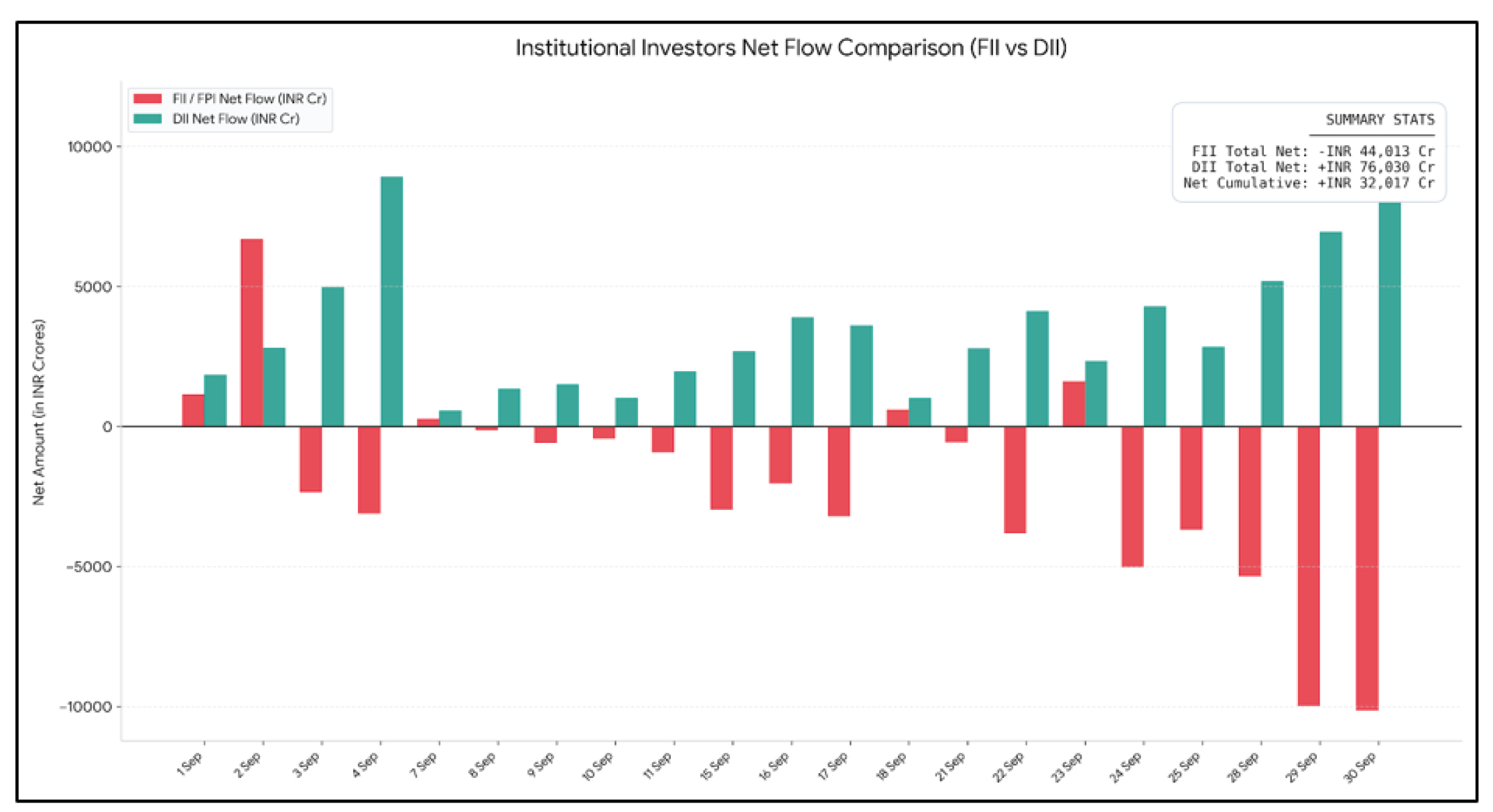
The impact of FII selling was, however, partly absorbed by strong domestic institutional participation. DIIs, including mutual funds, insurance companies and other domestic financial institutions, remained consistent buyers, recording net purchases of ₹62,220 crore in the exchange cash-market data. Their buying was supported by continued domestic investment flows and helped provide liquidity during periods of foreign selling. Interestingly, foreign investor sentiment improved towards the end of October, with FPIs returning as net buyers and infusing approximately ₹6,300 crore during the final week, October 26–30. This reversal, along with improving corporate earnings and domestic buying, contributed to the recovery in benchmark indices. It is worth noting that depository-based FPI flow figures and exchange-based FII cash-market figures differ because they cover different transaction categories and settlement periods. Depository data separately reported net equity outflows of approximately ₹34,843 crore for October. On the domestic front, the Reserve Bank of India's monetary policy decision also influenced investor sentiment. The Monetary Policy Committee raised the repo rate by 25 basis points to 5.50% on October 7, shifting towards a calibrated tightening stance amid inflationary concerns. The rate hike initially weighed on interest-rate-sensitive sectors, particularly banking and other businesses dependent on borrowing costs, as investors assessed its implications for credit growth, consumption and corporate profitability. Nevertheless, the market witnessed a notable turnaround during the latter half of the month, supported by relatively resilient September-quarter corporate earnings and improving investor confidence. The information technology sector emerged as the strongest performer, with the Nifty IT index gaining approximately 17.69%, supported by encouraging quarterly results, growing interest in artificial intelligence-led business opportunities and attractive valuations following earlier corrections. Positive earnings announcements from selected companies also encouraged selective investment in large-cap stocks. Furthermore, expectations of a possible reduction in the long-term capital gains tax rate from 12.5% provided an additional boost to sentiment, although no such policy change had been officially announced. Despite the recovery in benchmark indices, broader market performance remained subdued. The Nifty Midcap 100 and Smallcap 100 declined by